

Worm mix for soil improvement
Specially composed mix of surface-dwelling and deep-burrowing worms for aerating compacted soil, natural drainage and restoration of soil life.
Without drainage pipes: worms help with compacted ground and standing water.
Nowhere else in the Netherlands: 50% deep-burrowing worms, 50% litter-layer dwellers: together they aerate the subsoil and process organic material.
Ideal for gardens and lawns: 1 kg is enough for 50 to 100 m².
€43.95/1 kg
Choose your quantity
9 % korting
✕Out of stock
1
Send me an email when the product is back in stock.
Secure payment
iDEALKlarnaSEPAKBCPay
Shipped within 1-3 days (NL)
Free pickup at our location
4.8 rating on Google
Goes well with


Description
The worm mix is specially composed for soil improvement in gardens and lawns. It helps drain the ground better and makes compacted soil more airy by means of worms. This mix contains several species of worms.
Important points of attention
The worm mix for soil improvement is not shipped when the temperature is around 25 degrees Celsius. Please note: the worm mix must be released above 5 degrees Celsius. Because the worms are also released in greenhouses, we do ship the worms below 5 degrees. You are responsible for monitoring the temperature yourself before releasing them.
The worm mix for soil improvement is best released on the day of delivery. It is not advisable to store the worms for several days. If it is necessary to store the worm mix, this is best done at 5 - 15 degrees Celsius.
Do not use artificial fertiliser:
Stop using artificial fertiliser after releasing the worms. Fertiliser harms soil life and hinders the development of a healthy ecosystem.Provide organic material in the garden:
Leave pruning waste and leaf residue.
Leave the grass clippings on the lawn when mowing.
Add compost, worm castings or mulch to create a nutritious top layer.
Not suitable for worm bins:
This mix is exclusively intended for use in open ground.
Some species in this mix cannot survive in small or closed systems such as compost bins or worm towers.
Result:
When applied correctly, these worms provide improved soil structure, better water permeability and healthier soil life – the basis for a vital, living garden.
Article from Wageningen University Earthworms and their key role in the soil.
Solution for drainage and compacted soil problems
Gardeners increasingly face drainage problems due to applied soil, for example in new-build situations. Standing water and a compacted layer that disturbs the soil.
Disruptive layers If the garden has already been established, installing drainage pipes can be a huge and costly intervention. Not to mention the damage it causes to the existing vegetation. In nature, it is among others the worms that are responsible for a well-permeable soil. The countless tunnels ensure that water reaches the top layer of the soil faster. By deploying different worms, each with their own characteristics, both shallow temporary tunnels and permanent tunnels that go several metres deep into the soil are created. This combination of different worms ensures that disruptive layers can be broken through. Plants and trees also use these countless tunnels to easily send their roots deep into the soil, which in turn also has a positive effect on the disruptive subsoil. This allows plants and trees to more easily absorb moisture from deeper layers of the soil during dry periods.
Biodiversity In addition, the worms help restore soil life and biodiversity. The worms spread organic material, bacteria and fungi through the soil via their droppings (worm castings). This helps the garden create a healthy and natural soil, especially when a mulch layer is used and artificial fertiliser is no longer used.
Result Results in terms of drainage always take some time. Usually the first results are visible after a season, although plenty of customers experience the effect within a year. Should the result unfortunately be disappointing, it may be necessary to introduce a new batch of worms until the desired result is achieved. Before new worms are introduced, information can always be gathered again to make the project as successful as possible.
Worm farm Wasse and Franky's Flora from Beilen in Drenthe. The specialist in soil improvement of – as they themselves say – 'a different way of gardening and farming'.
Frank Wasse van Dijk started his worm farm in 2016. A year later, the brand name Franky's Flora was added. 'Nature and biodiversity are our starting point when it comes to soil improvement'. We look at what the soil needs to achieve a top result. The knowledge teaches that the plant, shrub (or any other crop) can extract its own nutrition from the soil at the moment the plant needs it. In Franky's Flora's view, everything grows better on good soil. The soil is the foundation. Worm castings are a living product and a fantastic soil improver. One hundred percent natural, friendly to soil animals and organic!
Ingredients & recipe
Worms present in the mix:
Eisenia Hortensis, Eisenia Fetida - 50% of this mix are litter-layer dwellers. These are the worms that can process a lot of organic material.
Lumbricus terrestris - 50% of this mix are deep burrowers; these are the most important worms in the mix. Unfortunately, these are also the most expensive worms. When comparing prices, it is important to know what percentage of these worms is in the mix. These are the worms that provide good drainage. Without these worms, the mix does not work for drainage.
Each species has its own positive properties for the soil. This mix contains worms that live in the top layer of the soil. These worms dig tunnels in the top 40 cm of the soil and process the litter layer (leaves, twigs, etc.), and worms that also live deeper in the ground. These worms dig tunnels deep into the soil. This provides extra air and better drainage for the soil.
The ratio between these types of worms is approximately 50% – 50%
Why the 50% ratio?
We chose this ratio because dew worms reproduce much more slowly than compost worms. More dew worms provide better drainage.
How to use it
Instructions for use – Worms for Soil Improvement
Dosage:
1 kg of garden worms is suitable for approximately 50 m² to 100 m² of garden surface.
Packaging:
Packed per 1 kilo or packed per 5 kilo when purchased with a discount of 10 kg at once.
Application in the garden
Moisten the soil:
If the ground is dry, spray the soil wet before releasing the worms. This makes their access to the soil easier and reduces stress.Distribute the worms:
Distribute the contents of the bag over the desired surface. When the weather is warm and dry, it is better to make at most 2 small piles from a 1 kg bag. The worms have protection by being together; this gives the worms a greater chance of success. It is best to release the worms on the most problematic spots. The worms will eventually distribute themselves in the soil. To give the worms a helping hand, it can help to briefly spray the pile of worms wet with a watering can. This ensures that the worms enter the soil faster.Do not dig in:
Place the worms with the supplied substrate on top of the ground. Do not dig the worms in – they will crawl into the soil themselves in search of the right conditions. The substrate temporarily protects the worms from drying out and predators. Covering the worms with, for example, a bucket will also make it take longer for the worms to crawl into the ground.Time of release:
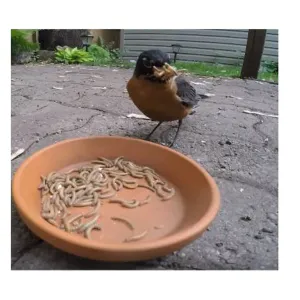
Release preferably in the evening, when fewer birds are active. Releasing during the day is possible, but then keep an eye on whether the birds do not spot the worms.
Minimum soil temperature: 5°C. At lower temperatures, the worms are inactive and vulnerable.
Technical details
- Available product variants: 3
- Option groups: 1
- Options: 2
Some alternative solutions

Frequently asked questions
Can I use lava meal and the worm mix on the same day?
Absolutely, that is fine on the same day. Just make sure you do not release the worms directly into pure lava meal, or moisten everything with the garden hose before releasing the worms.
Which worms are in the mix and why can't they all go in a worm bin?
The mix consists of 50% compost worms (live shallow, process organic material) and 50% dew worms/deep burrowers (go metres deep into the ground and create lasting, airy tunnels). Only the dew worm is not suitable for a worm bin — for that you choose the compost worm mix.
Which worm species are in the soil improvement mix?
The mix consists of approximately 50% Eisenia hortensis and Eisenia fetida and approximately 50% Lumbricus terrestris.
At what temperatures can the worms be shipped and released?
Release: The minimum soil temperature must be 5°C (at lower temperatures they are inactive and vulnerable).
Shipping: We do not ship the mix at outdoor temperatures around 25°C or higher. Because the worms are also used in greenhouses, we do ship them below 5°C (the customer must check the local soil temperature themselves before release).
What maintenance tips apply after release?
Stop using artificial fertiliser: Fertiliser harms soil life and hinders the development of the ecosystem.
Provide organic material: Leave pruning waste, leaf residue or mowed grass on the lawn, or add extra compost, worm castings or mulch.
When can I expect results for drainage problems?
Results for drainage take time. Usually the first effects are visible after a season, although some customers experience them within a year. Should the result unfortunately still be insufficient due to extreme compaction? Then a new batch of worms is needed. In that case, you can contact us in advance for advice to make the project as successful as possible.
What do customers think?
5.0
23 reviews
Showing 3 of 23 reviews
- 22 September 2026
Dorine
Dag, ik heb een kleine tuin van 6x6 m bij een nieuwbouwwoning. De grond is erg hard en water loopt nauwelijks weg. Ik hebbhet hoge onkruid verwijderd en wil de bodem zo natuurlijk mogelijk voorbereiden voor planten. Wat moet ik doen?
Reply from Wormenkwekerij Wasse
Beste Dorine, Bedankt voor je vraag. Dit probleem horen we vaker bij nieuwbouw. In dit geval is het beste om met de buren samen wormen uit te zetten. Voor een oppervlakte van 36 m2 is een halve kilo meestal voldoende maar als je de enige bent is het een druppel op een gloeiende plaat. Het mooiste is dat minimaal de buren meedoen. Daarnaast is het aan te raden om met een mulchlaag te werken. Je zorgt dat de wormen dan graag in de tuin blijven en vermenigvuldigen. Hiermee zou je de bodemstructuur weer kunnen herstellen. Als er nog vragen zijn dan hoor ik het graag. Mvg Frank
- 28 May 2026
Sarah
Hallo, ik heb een vraag. Ik heb sinds dit seizoen een moestuin. Ik heb ongeveer 10 cm compost op de bestaande grond. De bestaande grond is kleigrond, wordt de grond ook luchtiger met kleigrond? Groetjes Sarah
Reply from Wormenkwekerij Wasse
Hoi Sarah, Het gebruiken van wormencompost maak inderdaad de klei bodem luchtiger. Eventueel kan je ook nog lavagruis gebruiken om de bodem luchtiger te maken. Ook het aanbrengen van een mulchlaag helpt. Als er nog vragen zijn dan hoor ik het graag. Mvg Frank
- 30 October 2025
Ti-ta-toverworm
Bedankt Duco voor het geschreven kaartje. Eergister laat besteld en vandaag binnen, zojuist in de avond uitgezet op mijn maandag aangelegde ecologische gazonnetje/speelveldje. Wel eerst even het gazonnetje besproeid. Hopelijk vinden ze de topping van goedkope bemeste tuinaarde wel te nassen, daaronder vinden ze een mooie dikke laag bio-bemeste tuinaarde en daaronder klei. Kan ik nog meer doen om ze op hun plekje te houden en om ze mijn gazon van lucht te voorzien?
Reply from Wormenkwekerij Wasse
Bedankt voor je bericht Tony, Je hebt het de wormen al aardig naar hun zin gemaakt. Dit zou voldoende moeten zijn, maar als tip is het aan te raden om tijdens het grasmaaien de snippers op het gazon te laten liggen. Dit wordt voeding voor de wormen en het gazon. Let erop dat het wel kleine snippers zijn anders dek je het gras teveel af. Heel veel succes met tuin! Groeten Frank